Beyond the Booth: Six Due-Diligence Questions for Korean Aesthetic Buyers in 2026
Updated: 1 day ago
The strongest aesthetic-industry partnerships rarely begin with a product claim. They begin with a better question: what evidence, documentation and support would make this innovation ready for a particular market? For distributors, clinic procurement teams and Korean manufacturers exploring international partnerships, that distinction is more important than ever.
Exhibitions and supplier showcases bring together innovative dermatology products, aesthetic technologies and professional buyers. Yet exhibition visibility is not evidence of a product's efficacy, nor does a meeting at a booth establish regulatory authorization. A structured due-diligence process helps separate an interesting product introduction from a viable commercial partnership.
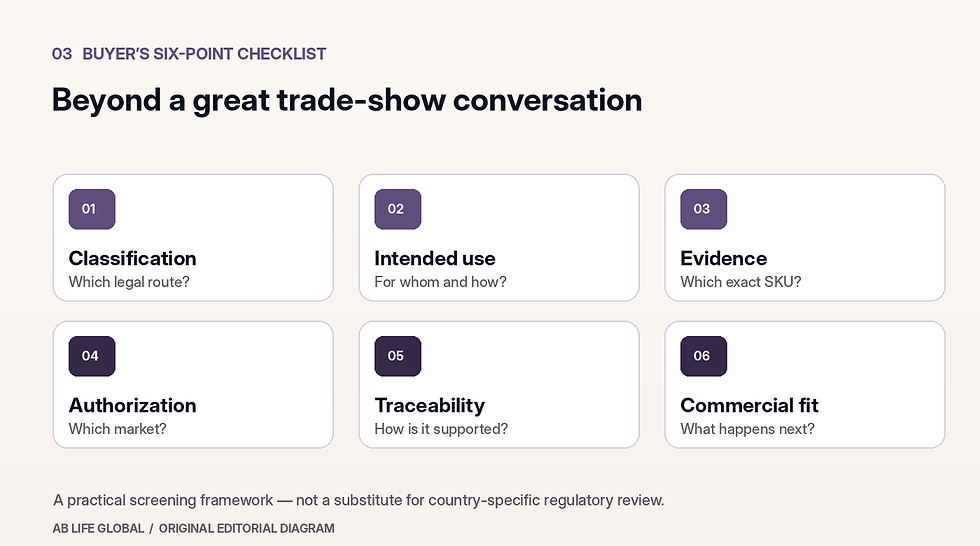
Here are six practical questions that can help professional buyers move from discovery to responsible market assessment. This is a commercial due-diligence framework, not clinical advice or a substitute for a regulator’s decision.
1. Which category does the product actually belong to?
A label such as 'skin booster,' 'regenerative aesthetic solution' or 'professional treatment' does not by itself identify the legal product category. A product's intended use, composition, presentation and design all matter. Buyers should identify the applicable product classification and authorization requirements with the competent authority of their intended market before commercial distribution.
For a buyer, this means requesting the manufacturer’s exact intended-use statement before drafting advertisements, training materials or forecasts. A topical cosmetic, a device and an injectable preparation should not be treated as interchangeable simply because they appear at the same exhibition. Where the classification is uncertain, the sensible next step is a formal, product-specific determination from the relevant authority.

2. Does the documentation match the exact product and model?
Ask for the legal manufacturer’s identity, manufacturing site, precise product name, model or variant, formulation or technical specification as relevant, shelf-life and storage conditions, labels, instructions for use, and evidence of the manufacturer’s quality controls. Check that these documents point to the same item that appears in the catalogue and quotation.
EDE’s published medical-device authorization requirements, for example, list manufacturing and registration evidence, quality-conformity documentation appropriate to device classification, product descriptions and models, packaging, warnings and post-marketing monitoring information. That is a useful illustration of why a glossy brochure is only one part of a serious assessment. A certificate issued for a manufacturer is not, on its own, proof that every product or every proposed indication is authorized in the destination country.
3. Is the evidence appropriate to the claim?
Professional buyers hear many compelling phrases: “advanced hydration,” “rejuvenation,” “collagen support” and “next-generation technology.” These can be useful descriptions of a research direction or marketing positioning, but they should not be repeated as established clinical outcomes without matched support.
Evidence review should start with the exact formulation, device configuration and intended use. Then examine study design, comparator, sample size, measured endpoints, study population, follow-up period, safety reporting and limitations. A laboratory experiment, preliminary observational study and controlled clinical study answer different questions. Results from one formula, technique or patient population should not automatically be transferred to another.
In a business conversation, a disciplined phrase is often more valuable than an expansive promise: “This feature is described in the manufacturer’s materials; the supporting technical dossier and territory-specific permissions must be reviewed before claims are used.”

4. Is the product authorized — and is the proposed promotion permitted — in this market?
Regulatory pathways are country-specific. Depending on the destination market, medical devices and professional aesthetic products may require different classification, conformity assessment, registration, distribution and advertising permissions. Foreign registration, an ISO certificate or a CE-related document may form part of a technical dossier but should not be presented as blanket approval elsewhere.
There is also a distinction between the product’s authorization and permission to advertise it. EDE’s service for licensing medical-product advertisements covers websites and social media among other formats and calls for truthful, evidence-supported information consistent with approved indications, subject to the product and applicant category. Before publishing product-specific promotional claims, confirm whether this service or other advertising controls apply. A business-facing educational article does not itself certify any featured product.
5. Can the distributor support the product after the first order?
A sustainable partnership needs more than a launch presentation. Buyers should understand batch and lot traceability, distribution channels, handling and storage responsibilities, product authentication, complaint escalation, recall communication and the availability of accurate training documents. These questions are especially relevant when products are intended for professional use or involve sensitive storage conditions.
Ask practical questions: Who provides the current labels and instructions? Who receives complaints? How are manufacturer updates communicated? Who checks that images, model numbers and claims stay consistent across sales pages, clinic brochures and social posts? A credible supplier should be able to explain the process without relying on vague statements such as “internationally approved.”
6. Is there a commercially realistic fit for the clinic or channel?
After regulatory screening, examine buyer needs. Retail skincare, professional cosmetics, aesthetic devices and clinic-facing products often involve different stakeholders, training requirements, reorder cycles and service expectations. A good product for one channel may not be suitable for another. Forecasts should use verified local demand, credible lead qualification and clear after-sales commitments rather than assuming trade-show attention will convert directly into repeat orders.
A simple follow-up record can capture the buyer’s market, channel, intended customer, required documents, status of local review, preferred next step and unanswered questions. This keeps the discussion specific and helps manufacturers avoid preparing a single, one-size-fits-all presentation for every country.
How AB LIFE GLOBAL approaches cross-border conversations
AB LIFE GLOBAL works to connect Korean beauty and professional-aesthetics innovation with distributors, retailers, clinics and commercial partners in international markets. Our conversations span consumer-facing skincare and professional product categories; examples from the wider portfolio include Bright, DermaNique and Soylab, alongside professional-aesthetics names such as Si Belle and BELLUTI. These references describe a portfolio conversation, not any product’s regulatory status or an efficacy endorsement.
We believe the most useful introduction is a structured one: clarify the partner’s business model, provide manufacturer-authorized product information where available, separate educational technology discussion from substantiated performance claims, and identify the country-specific documentation that still needs verification. That approach supports a premium brand image because it respects both clinical judgment and the realities of procurement.
For Korean manufacturers, a strong distributor inquiry should identify the destination country and intended channel before discussing exclusivity or launch timing. For professional buyers, an effective first request is a product-specific dossier checklist rather than a broad 'send everything' message. Both sides save time when unknowns are made visible early.
Professional takeaway: evaluate readiness, not just novelty
Korean aesthetics continues to attract global interest through innovation and industry events. The practical advantage goes to partners who can separate product discovery from evidence review, and marketing appeal from destination-market authorization. Six questions — category, documentation, evidence, permissions, after-sales support and commercial fit — make that assessment easier to organize.
If you are a distributor, clinic group, buyer or Korean manufacturer exploring a responsible collaboration, contact AB LIFE GLOBAL at dypark@ablife-global.com or visit www.ablife-global.com. Please include your country, intended channel and product category so our team can respond with relevant, verified information.
Editorial note (21 October 2026): This article summarizes publicly available information for professional market education. Requirements can change and depend on the product and jurisdiction. Nothing here asserts approval, availability, clinical benefit or intended use for a named AB LIFE GLOBAL product.

Comments